Best Ice Presses (November 2026)
A press shapes ice. It does not clarify it. Everything else about this purchase follows from that one sentence.
By Scooter M. · · How we pick

How this page is paid for: the buy buttons below are Amazon affiliate links. If you buy through one we earn a small commission, and you pay exactly the same price. Prices shown were last checked November 25, 2026. Nobody pays to appear here. Full disclosure.
Quick picks
The short answer, ranked. Tap any row to jump to the full write-up further down this page, or go straight to Amazon for the live price.
| # | Product | Best for | Price |
|---|---|---|---|
| 1 | 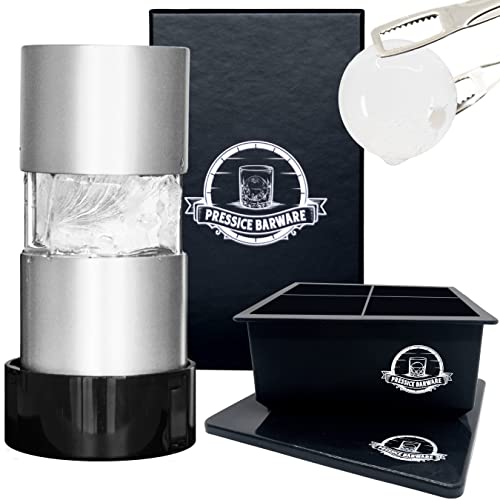 Pressice Barware Ice Ball Press with Drip Tray and Mold Anodized aluminum, a published 58 mm sphere in under a minute, with the mold and drip tray in the box. | Best overall | $109.99 · View on Amazon #ad Checked November 25, 2026 |
| 2 | 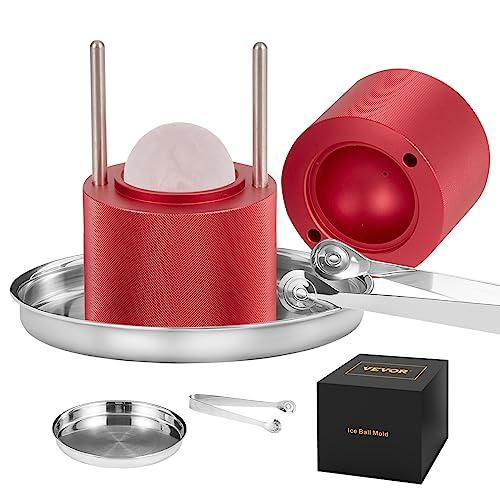 VEVOR Ice Ball Press, 2.4 in / 60 mm, Aviation Aluminum 60 mm published, which is about 70% more ice than a 50 mm ball. Cheapest route into a metal press. | Best large sphere | $68.31 · View on Amazon #ad Checked November 25, 2026 |
| 3 | 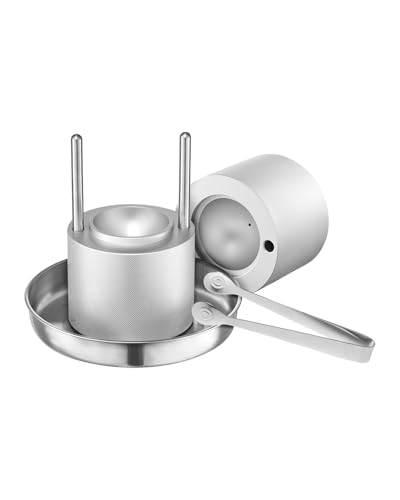 VEVOR Ice Ball Press, 2.1 in / 53 mm, Aviation Aluminum 53 mm, for the very common rocks glass that a 60 mm ball will not go into. | Best for a narrow glass | $79.02 · View on Amazon #ad Checked November 25, 2026 |
| 4 | 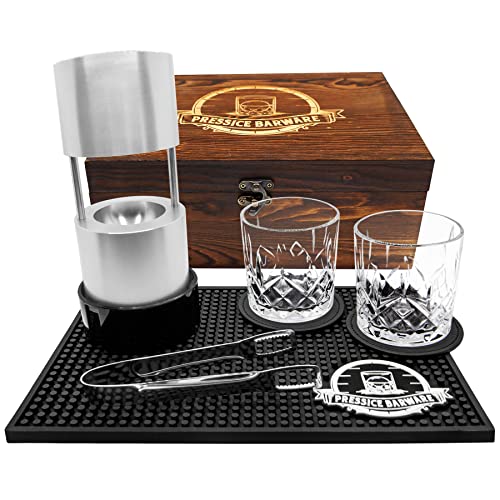 Pressice Barware Ice Press Kit, 2.3 in Sphere, with Mold and Accessories The same press with mold, mat, tongs, glasses and a pine box. Nothing else to buy. | Best as a gift | $119.99 · View on Amazon #ad Checked November 25, 2026 |
| 5 | 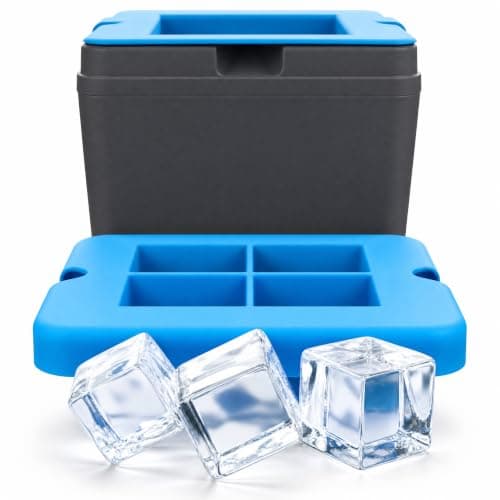 True Cubes Clear Ice Cube Tray (TC1) The press shapes clear ice. This is the tray that makes it. | What you have to buy first | $33.10 · View on Amazon #ad Checked November 25, 2026 |
Buy the Pressice Barware press: anodized aluminum, a published 58 mm sphere in under a minute, and the mold and drip tray are in the box. If you want the largest sphere for the least money, the VEVOR 60 mm press is the one, and it publishes a weight where Pressice does not. Before either, understand this: a press does not make clear ice. It shapes ice you have already made clear, and if you have not solved that yet, start there.
Our ice molds page has been live for over a year and it ranks four molds and no presses, despite having both words in the title. That was an honest gap: a press is a different product at five to ten times the price, and it deserved its own page.
It also deserved a page that leads with the correction, because the listings in this category do not. Search results are full of presses photographed next to perfectly clear spheres, with no mention anywhere that the clarity came from the ice rather than the press.
How we judged these
Is the sphere diameter published?
In millimeters, by someone. This is the number that decides whether the ball fits your glass, and it varies from 53 mm to 60 mm across presses that look identical.
Is the alloy published?
Anodized, aviation-grade or 7075 aircraft aluminum. Bare aluminum stains, and anodizing is the difference between a press that looks good in year three and one that does not.
Is a weight published?
Weight is what makes a press work - more mass, faster forming. One brand publishes it and one does not.
Does it come with the mold that feeds it?
A press needs a block of the right size. A press sold without one is an incomplete purchase, and the good kits include it.
Is there anywhere for the meltwater to go?
Pressing an ice ball produces a surprising amount of water. A drip tray is not an accessory in this category, it is part of the tool.
The four presses, compared
| Pressice press | Pressice kit | VEVOR 60 mm | VEVOR 53 mm | |
|---|---|---|---|---|
| Sphere | 58 mm (2.3 in) | 58 mm (2.3 in) | 60 mm (2.4 in) | 53 mm (2.1 in) |
| Alloy | Anodized aluminum | Aircraft-grade aluminum | Aviation aluminum; 7075 on one kit | Aviation aluminum |
| Published weight | Not published | Not published | 7.05-8.8 lb depending on SKU | 7.05 lb (3.2 kg) |
| Mold included | Yes | Yes, silicone with lid | On some SKUs | Not stated |
| Drip tray | Yes | Yes | Yes | Yes |
| Tongs | No | Yes | Yes | Yes |
| Extras | None | Bar mat, 2 glasses, coasters, pine box | Mat and glass on some SKUs | None |
Note the weight row. VEVOR publishes a figure and it varies by nearly two pounds across SKUs with the same description; Pressice publishes none at all. On a tool whose entire mechanism is mass and thermal conductivity, that is the specification we would most like to have and the one the category is least willing to print.
What a press actually does, and what it does not
Aluminum conducts heat about a thousand times better than ice. Put a room-temperature aluminum block against a cube and the ice in contact with it melts almost immediately; shape a hemisphere into the block and the cube sinks into that shape under its own weight. Thirty to sixty seconds later you have a sphere and a tray of water.
That is the whole mechanism. There is no motor, no lever and no hinge — the press is two pieces of machined metal, which is why nothing on it can fail and why the price is simply the cost of the aluminum and the machining.
And that is also why it cannot clarify anything. Cloudiness in ice is dissolved air and minerals trapped as the water froze from all sides at once. Melting a shape into a cloudy cube removes the outer layer and leaves the trapped air exactly where it was. If the sphere in the photograph is glassy, the cube that went in was. Directional freezing is how that happens, and it is a cooler and a freezer rather than a press.
Will the sphere fit your glass?
This is where most of the disappointment in this category comes from, and it is easy to check in advance. A sphere has to clear the rim of the glass with room for fingers or tongs, which is about 15 to 20 mm of margin. So a 53 mm ball wants a rim of roughly 70 mm, and a 60 mm ball wants about 80 mm.
Rim diameters on real glasses are smaller than people assume. The published figures on our own glassware pages range from 39 mm on a Glencairn copita, through 63 mm on a Norlan, to 83 mm on a Zwiesel nosing tumbler. A 60 mm sphere fits the last of those and not the first two.
Which is why the smaller VEVOR press is on this page at all. It is not a budget version of the big one — at the prices we saw it actually cost slightly more for less metal — it is the press for people whose glasses are normal. The rocks glasses page has the shapes, and if you are buying both at once, buy the glass first and the press to fit.
Press, mold or machine
A silicone sphere mold costs a few dollars and makes a good ball overnight. A press costs a hundred or more and makes one in under a minute from a cube. A clear ice system makes the clear cube in the first place. These are three different purchases and the order matters: the system, then the mold, then the press.
Our mold against press against machine page sets out that decision in full, and the molds roundup ranks the trays and molds — including the clear-ice tray that is a pick on this page too, because without it a press has nothing worth shaping.
The honest case for the press is entertaining. Spheres on demand, one a minute, in front of people, out of a block you prepared earlier. It is theater as much as physics, and it is the same category of purchase as a cocktail smoker: nobody needs it, and the people who want it are not confused about that.
How a press actually gets used
The workflow is the part no listing explains, and it is the reason the kits include a mold. You freeze a block larger than the finished sphere — the mold in the box is sized for it — let it temper for a few minutes out of the freezer so it is not brittle, set it in the press, and wait.
Tempering matters more than it sounds. Ice straight from a freezer at 0 F is colder than it needs to be and will crack rather than deform under a warm press. Five minutes on the counter takes the surface up to the point where it melts cleanly, which is when a press works best and the sphere comes out glassy rather than fractured.
The block size is the other input, and it is the reason the kits bundle a mold. Too small and the press closes on air, leaving a flattened disc rather than a sphere; too large and the excess has to melt away before the halves meet, which takes minutes rather than seconds and wastes most of the cube. A mold matched to the press removes the guesswork entirely, which is why a press sold without one is an incomplete purchase.
The first press of an evening is also the slowest. The press starts at room temperature and loses heat into every sphere it makes, so the second and third take longer as the metal cools — which is the one real argument for a heavier press, and the reason a published weight would be useful.
Then there is the water. A sphere displaces its own shape in meltwater, and that has to go somewhere: the drip tray is part of the tool rather than an accessory, and a press used over a counter without one makes a mess every time. The meltwater is also the reason a press is a bar-top tool rather than a kitchen-drawer one — it wants a surface you can wipe and a sink within reach. Store the finished spheres in the freezer in a covered container rather than loose, because bare ice in a frost-free freezer sublimates and goes cloudy on the surface within a day.
What we could not recommend, and why
A thousand-dollar solid aluminum press from a boutique brand was in stock at four units when we checked, and we do not feature a listing we expect to go dark. Two other presses at the $240 to $250 mark are from brands whose names return nothing outside the marketplace, with no published alloy and no published sphere diameter.
We also excluded the stainless and silicone “ice ball maker” molds that appear in the same searches. They are molds, they work, and several are good value — but a mold is a different product and conflating the two is the thing this page is trying to fix. They belong on the molds page, which is where they are.
One documentation note on the press we picked. The Pressice sphere is published as 58 mm by one retailer and the bare press as 2.3 inches by another, which converts to 58.4 mm — those agree. What nobody publishes is its weight, and the prices quoted across retailers for the same press varied widely enough that we have described its band rather than printing a number.
What else the sphere needs
Clear ice, first and always. A tray that freezes directionally is the precondition for everything on this page, and the ice cube trays page covers the cheaper options if a dedicated clear-ice system is more than you want to spend.
Tongs, because a 58 mm sphere out of a press is wet and slippery and fingers leave marks on a glassy surface. The scoops and tongs page covers which ends grip a sphere and which slide off it — the answer is claws rather than teeth.
And a glass worth putting it in. A sphere in a thin tumbler is a mismatch; the whiskey glasses page has the heavy based options, and the nosing glass page covers the other half of whisky drinking, where ice does not belong at all.
The picks, in full
1. Best overall
Pressice Barware Ice Ball Press with Drip Tray and Mold
Pressice Barware · best for a sphere in under a minute, from ice you already made clear
An anodized aluminum press that forms a 58 mm (2.3 in) sphere in less than a minute by melting its way through a block under its own weight and warmth. It ships with the mold that makes the block and the tray that catches the meltwater, which is the part most presses leave you to solve.
Published specs
- Sphere size
- 58 mm (2.3 in), published by Brookstone
- Material
- Anodized aluminum
- Included
- Ice press, drip tray and ice mold
- Wells
- 1
- Origin
- The retail title states "Made in the US"; we found no independent confirmation
- Weight
- Not published by any source we could find
The math
- Why a press needs no power: Room-temperature aluminum does the work
- Aluminum conducts heat roughly a thousand times better than ice. A room-temperature block of it resting on a cube melts a sphere-shaped cavity into the ice and the cube settles into it under its own weight. There is no motor, no mechanism and nothing to break - the press is a single piece of metal.
What’s good
- Mold and drip tray included, so the press arrives as a complete workflow
- Anodized rather than bare aluminum, which is the finish that resists the staining
- A sphere in under a minute, repeatedly, with no moving parts
What’s not
- It shapes ice; it does not clarify it. Cloudy ice in means a cloudy sphere out
- No published weight, which for a press is the specification that determines how fast it works
- Prices across retailers for this press ranged widely when we checked, which makes the value hard to pin
Skip this if
Anyone who has not solved clear ice first. A press on top of freezer-tray ice produces an expensive cloudy ball.
#ad Price checked November 25, 2026. We may earn a commission at no cost to you. Disclosure.
Where these numbers come from
2. Best large sphere
VEVOR Ice Ball Press, 2.4 in / 60 mm, Aviation Aluminum
VEVOR · best for the biggest published sphere here, at the lowest price in the category
Sixty millimeters - 2.4 inches - which is the largest sphere any press on this page publishes, from aviation aluminum, with a tong and drip tray in the box. VEVOR publishes a weight for its presses, and weight is what makes a press fast.
Published specs
- Sphere size
- 60 mm (2.4 in)
- Material
- Aviation aluminum (one kit variant is published as 7075 aircraft aluminum)
- Press dimensions
- 3.9" x 5.9" on one published listing
- Weight
- Published between 7.05 lb (3.2 kg) and 8.8 lb (4 kg) depending on the SKU; one kit publishes a 6 lb (2.7 kg) press
- Included
- Press, tong and drip tray; some SKUs add a mold, mat and glass
- Model codes seen
- KH-B02 and TM-60 across variants
The math
- Why the 60 mm sphere matters: About 70% more ice than a 50 mm ball
- Volume scales with the cube of the diameter. A 60 mm sphere against a 50 mm one is (60/50) cubed, or about 1.73 - roughly 70% more ice in the glass, melting proportionally slower. That is the whole argument for the larger press.
What’s good
- Largest published sphere on this page, and the physics of dilution follows the diameter
- Published weight, which Pressice does not give at all
- Cheapest route into a metal press by a wide margin
What’s not
- Published weight varies by nearly two pounds across SKUs with the same description
- Kit contents change between variants, so check the model code before buying
- No maker spec sheet resolves the discrepancies - the figures come from retailers
Skip this if
A glass that cannot take a 2.4 inch ball. Measure the rim of your rocks glasses first.
$104.99 — 35% off
#ad Price checked November 25, 2026. We may earn a commission at no cost to you. Disclosure.
Where these numbers come from
- VEVOR — ice ball press kit on the maker's own site, published aircraft aluminum construction and contents
- Houzz — VEVOR ice ball press 2.4 in / 60 mm, published press dimensions, weight and contents
- Lowe's — VEVOR aluminum sphere ice mold, published material and model data
- VEVOR Ice Ball Press, 2.4 in / 60 mm — retail listing
3. Best for a narrow glass
VEVOR Ice Ball Press, 2.1 in / 53 mm, Aviation Aluminum
VEVOR · best for a narrower rocks glass, where a 60 mm ball will not go in
Fifty-three millimeters, for the very common case of a rocks glass whose rim is narrower than the press everybody recommends. Same aviation aluminum and the same tong and drip tray; the only thing that changes is the diameter you can actually serve.
Published specs
- Sphere size
- 53 mm (2.1 in)
- Material
- Aviation aluminum
- Net weight
- Published at 3.2 kg / 7.05 lb for the 53 mm kit
- Included
- Press, tong and drip tray
The math
- Does it fit your glass: A 53 mm ball needs about a 70 mm rim
- A sphere has to clear the rim with room for fingers or tongs, which is roughly 15 to 20 mm of margin. 53 mm plus that margin is about 70 mm, or 2.75 inches. Our own published rim diameters run from 63 mm on a Norlan to 83 mm on a nosing tumbler - so on some glasses the smaller press is not a preference, it is the only one that works.
What’s good
- Fits glasses the 60 mm press cannot, which is a real constraint rather than a preference
- Published net weight, unlike most of the category
- Same build and accessories as the larger VEVOR press
What’s not
- A smaller sphere melts faster - about 40% less ice than the 60 mm version
- Costs slightly more than the larger press at the prices we saw, for less metal
- Same documentation problem as every VEVOR press: retailer figures, no maker sheet
Skip this if
A double old fashioned glass. If the rim takes 60 mm, take the bigger sphere.
#ad Price checked November 25, 2026. We may earn a commission at no cost to you. Disclosure.
4. Best as a gift
Pressice Barware Ice Press Kit, 2.3 in Sphere, with Mold and Accessories
Pressice Barware · best for a gift: the press plus everything it needs, in one box
The same 2.3 inch press packaged as a full kit - mold, bar mat, tongs, glasses and a pine box in the retailer's published contents list. As a gift it solves the problem that a bare press is a strange object to unwrap.
Published specs
- Sphere size
- 2.3 in (58 mm)
- Material
- Aircraft-grade aluminum, per the retail title
- Kit contents
- Brookstone publishes ice ball press, drip tray, bar mat, tongs, two whiskey glasses with leather coasters, silicone ice mold with lid and pine storage box
- Origin
- American owned and operated, per the retail title
What’s good
- The published contents list is the most complete in the category - nothing else to buy
- A pine box and glasses make it a present rather than a tool
- Same press geometry as the bare model, so the result is identical
What’s not
- You are paying for glasses and a coaster you may already own
- Kit contents are published by the retailer rather than the maker, and may vary by seller
- Still a press: it shapes clear ice, it does not create it
Skip this if
Yourself, if you already own glasses and a mat. Buy the bare press.
#ad Price checked November 25, 2026. We may earn a commission at no cost to you. Disclosure.
5. What you have to buy first
True Cubes Clear Ice Cube Tray (TC1)
True Cubes · best for the whiskey drinker, and anyone who has wondered why bar ice is transparent
Four 2" cubes of genuinely clear ice from a freezer, using directional freezing — an insulated shell that forces the ice to freeze top-down and pushes the cloudiness into a reservoir underneath. It is the cheapest impressive thing on this site.
Published specs
- Yield
- 4 cubes at 2" x 2" x 2"
- Freeze time
- About 18-22 hours
- Product dimensions
- 7"L x 7"W x 6"H
- Material
- BPA-free silicone tray in an insulated outer container
- Method
- Directional freezing — impurities and air are driven into the lower reservoir
- Recognition
- Named Best Clear Ice Mold by America's Test Kitchen
The math
- Cubes per day: 4
- One 18-22 hour cycle yields 4 cubes, so a single tray produces roughly 4 cubes a day. Two evenings of drinks for two people needs two trays, not one.
- Freezer footprint per cube: About 73 cubic inches
- 7" x 7" x 6" = 294 cubic inches of freezer space for 4 cubes. That is about 73 cubic inches per cube against 8 cubic inches of actual ice — the insulation is most of what you are storing.
What’s good
- Clear ice at home with no machine, no plumbing and no running cost
- A 2" cube melts far more slowly than standard tray ice, so the last mouthful is not water
- Directional freezing is a real physical method, not a marketing word — you can watch the cloud collect underneath
What’s not
- 18-22 hours per cycle means it must be planned a day ahead
- Four cubes at a time is not enough for guests
- The insulated shell takes up considerable freezer space for the ice it returns
Skip this if
A household with a small or crowded freezer. The shell is the size of a shoebox and it is holding four cubes.
$40.99 — 19% off
#ad Price checked November 25, 2026. We may earn a commission at no cost to you. Disclosure.
Questions people ask
Does an ice press make clear ice?
How does an ice press work with no motor or mechanism?
What size ice sphere should I buy?
Is a bigger ice sphere actually better?
Is an ice press worth it over a sphere mold?
How do you look after an aluminum ice press?
Why do ice presses cost so much?
Where these numbers come from
Every specification on this page is a figure the manufacturer or retailer publishes. We have not measured any of it ourselves, and every calculation shows its working so you can redo it.
- Brookstone — Pressice Barware ice ball press, published 58 mm (2.3 in) sphere and sub-minute forming time
- Brookstone — Pressice Barware ice ball press kit, published contents list
- Walmart — Pressice Barware ice ball press, published anodized aluminum construction, drip tray and mold
- VEVOR — ice ball press kit on the maker's own site, published aircraft aluminum construction and contents
- Houzz — VEVOR ice ball press 2.4 in / 60 mm, published press dimensions, weight and contents