Best gin and tonic glasses, and whether a copa is worth it
A gin and tonic needs 20 ounces of glass. Most glasses sold for one hold 14.
By Scooter M. · · How we pick
How this page is paid for: the buy buttons below are Amazon affiliate links. If you buy through one we earn a small commission, and you pay exactly the same price. Prices shown were last checked October 18, 2026. Nobody pays to appear here. Full disclosure.
Quick picks
The short answer, ranked. Tap any row to jump to the full write-up further down this page, or go straight to Amazon for the live price.
| # | Product | Best for | Price |
|---|---|---|---|
| 1 | 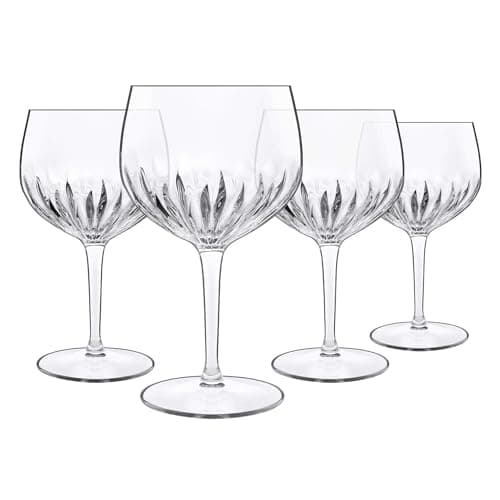 Luigi Bormioli Mixology Gin & Tonic Goblet, 27 oz, Set of 4 27 oz, which is the only capacity here that takes a full bottle of tonic over ice. | Best overall | $59.99 · View on Amazon #ad Checked October 18, 2026 |
| 2 | 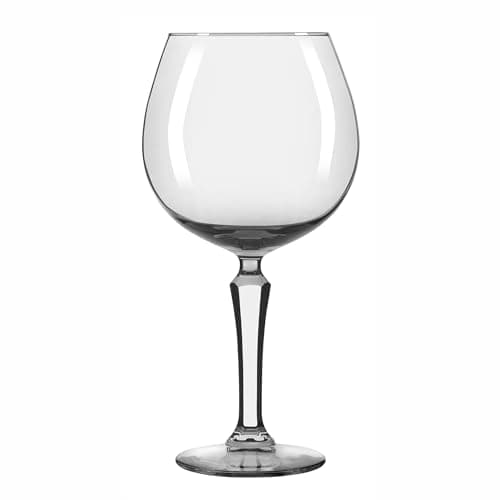 Libbey 602104 Speakeasy Gin & Tonic Glass, 19.5 oz, Case of 12 19.5 oz with every diameter published separately. Twelve of them. | Best for entertaining | $83.82 · View on Amazon #ad Checked October 18, 2026 |
| 3 | 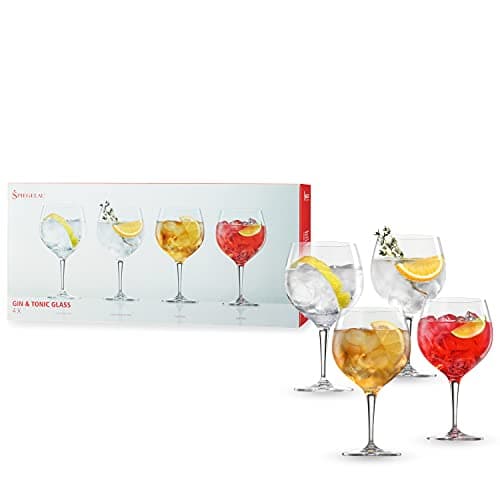 Spiegelau Gin & Tonic Glasses, Set of 4 630 ml on a long stem - but every figure comes from retailers, not Spiegelau. | Best German crystal | $42.99 · View on Amazon #ad Checked October 18, 2026 |
| 4 | 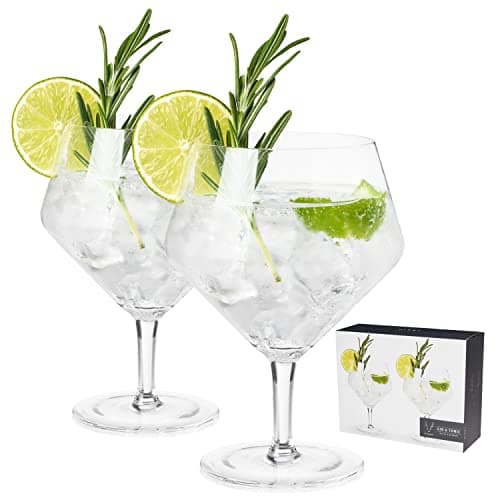 Viski Raye Angled Crystal Gin & Tonic Glasses, Set of 2 A boxed pair of lead-free crystal. Honest about being 14 oz and hand wash. | Best as a gift | $24.99 · View on Amazon #ad Checked October 18, 2026 |
Buy the Luigi Bormioli Mixology gin and tonic goblet: 27 oz, Italian, published dishwasher safe, four in a set. It is the only glass here with enough bowl to take a full load of ice, a 2 oz pour and an entire small bottle of tonic. Everything smaller is a compromise, and most of what is sold as a gin glass is roughly half the size the drink needs.
This is the rare glassware category where the right answer is counter-intuitive and easy to check. The gin and tonic is not a small drink pretending to be a big one. It is a genuinely large drink — two ounces of gin, a whole bottle of tonic, and enough ice that neither of those warms up — and the Spanish copa exists because Spanish bars worked out that a wine-sized glass cannot hold it.
Run the numbers on the glasses actually sold for this drink and a gap appears immediately. Capacities in the category run from 14 oz to 27 oz, which is close to a factor of two, and the listings use the same words for all of them.
How we judged these
Published capacity, and is it enough?
This is the gate. 20 oz is our floor, because below it a full ice load plus a 200 ml bottle of tonic does not fit.
Is it a stemmed bowl?
A gin and tonic is drunk slowly. A stem keeps a warm hand off the coldest part of the drink.
Published care instruction
A 27 oz bowl on a thin stem either survives a dishwasher or it does not, and only the maker knows.
Who published the figures?
A maker's own page beats a retailer's. Where only a retailer publishes, we say so on the product.
Does the set size match the buyer?
Two in a gift box, four for a household, twelve for a house that entertains. The right answer depends on who it is for.
The four, compared
| Luigi Bormioli | Libbey Speakeasy | Spiegelau | Viski Raye | |
|---|---|---|---|---|
| Capacity | 27 oz | 19.5 oz (576 ml) | 630 ml (21.3 oz) | 14 oz |
| Height | 8" | H 8" | 19.5 cm | Not published |
| Material | Glass, Italy | Glass | Crystal, Germany | Lead-free crystal |
| Care | Dishwasher safe | Not published | Dishwasher safe | Hand wash |
| Set size | 4 | 12 | 4 | 2 |
| Who published it | Retailers | Libbey sell sheet | Retailers only | Viski |
The bottom row is worth a moment. Libbey is the only maker here that publishes its own full dimensional specification for its gin and tonic glass, and Viski is the only one that publishes its own capacity, material and care. The two glasses with the most prestigious names on them — the German crystal and the Italian goblet — are both specified by shops rather than by the people who made them.
The arithmetic that decides this category
Fill a glass with ice to the shoulder and you have lost roughly two-thirds of its stated capacity. That is the whole calculation, and it is why a number that looks absurd on a listing turns out to be correct in a hand.
- 27 oz: about 9 oz of liquid over a full ice load. Two ounces of gin plus a 200 ml (6.8 oz) bottle of tonic is 8.8 oz. It fits, with room for the ice to begin melting.
- 19.5 oz: about 6.5 oz of liquid. Two ounces of gin leaves 4.5 oz for tonic — two thirds of a small bottle. Fine if you top up; short if you expect to empty the bottle.
- 14 oz: about 4.5 oz of liquid. A 2 oz pour leaves 2.5 oz of tonic, which is a gin and tonic in name only. This is the size most glasses marketed as gin glasses actually are.
The same arithmetic is why our highball page asks for 16 oz and why the highball versus collins comparison comes down to height rather than style. A tall narrow glass gets to the same liquid volume with less width, which is why a highball is a perfectly good gin and tonic glass and a small balloon is not.
Copa or highball: the honest answer
If you already own 16 oz highballs, you do not need to buy anything. A gin and tonic made in a tall glass with a full ice load and a whole bottle of tonic is the same drink, and the tall glass holds carbonation marginally better because less surface area is exposed.
What a copa adds is aromatics and comfort. The wide bowl holds the garnish — citrus peel, juniper, a slice of cucumber, whatever the gin suggests — above the liquid where you can smell it, and the inward curve at the rim keeps that air over the drink. The stem means a drink that is still cold at the end. Neither of those is a trick; both are modest.
So the decision is about frequency. A household that makes gin and tonics most weeks will notice the copa and keep using it. A household that makes four a year will have bought four large glasses that live at the back of a cupboard, and the money was better spent on almost anything else on the gin gifts page.
The same glass does an Aperol spritz
A spritz is built exactly like a gin and tonic: a large stemmed bowl, ice to the rim, and a long topper poured over. The standard build is three parts prosecco, two parts Aperol and a splash of soda, which lands at roughly the same finished volume as a gin and tonic over the same ice.
Italian makers have known this for years, which is why Luigi Bormioli sells its 27 oz goblet for gin, spritzes and sangria interchangeably and why the retail listings for it carry all three words. If someone in the house drinks spritzes and someone else drinks gin and tonics, this is one purchase rather than two.
It will also serve a large glass of wine, a sangria, a Negroni Sbagliato and an alcohol-free spritz built on an aperitif alternative, which is a better cupboard-space argument than most shape-specific glassware can make.
What to watch for when buying
Three traps in this category, all of them visible from the listing. First, the word “gin glass” attached to a 14 oz bowl — check the number, not the name. Second, hand-wash-only crystal: the Viski pair is honest about this, and it is genuinely a different ownership proposition from a dishwasher-safe set. Third, a maker whose own catalog no longer lists the glass.
That last one caught us here. Spiegelau’s gin glass is widely sold and well regarded, and Spiegelau’s own gin glasses category currently returns no products at all. Every figure on this page for that set — the 630 ml, the 19.5 cm, the dishwasher claim — comes from retailers. The glasses are presumably exactly as described. But a maker that has quietly dropped a line from its catalog is a maker you may not be able to replace a breakage from, and in a four-glass set of thin crystal that is a real consideration.
For everything else about judging a glassware brand before you buy from it, the brand ratings page sets out the six facts a manufacturer either publishes or does not.
The garnish is half of what the bowl is for
The capacity argument is the one that decides whether a copa works. The aromatics argument is the one that explains why Spanish bars started using them in the first place, and it is worth understanding because it changes how you fill the glass.
Gin is a distillate of aromatics. Juniper, coriander, citrus peel, angelica, whatever else the distiller chose — most of what you taste in a gin and tonic arrives through the nose rather than the tongue. A wide bowl with an inward curve at the rim holds that air over the surface of the drink, so every sip comes with the smell of the garnish attached.
Which is why the garnish in a copa is treated as an ingredient rather than a decoration. A strip of grapefruit peel for a citrus-forward gin, a few juniper berries and a bay leaf for a classic London dry, cucumber and mint for the softer modern gins, a slice of orange for anything with a bitter edge. These go in with the ice rather than on the rim, which is the practical difference between a copa and a highball: in a tall narrow glass there is nowhere for a garnish to sit except on top of the drink.
It is also the argument for the stem. A gin and tonic is drunk over twenty minutes or more, and a hand wrapped round the bowl is a reliable heat source for all of them. The stem is not styling; it is the same reasoning that puts a martini in a stemmed glass, applied to a drink that takes five times as long to finish.
How many to buy, and where to put them
Four is the number for a household, two is the number for a gift, and twelve is for somebody who hosts. That is the same answer as the rest of our glass-count arithmetic, with one complication specific to this shape.
Copas do not stack, do not nest, and will not stand upright in most dishwasher top racks. A 27 oz bowl is roughly 4.7 inches across and 8 inches tall, which is wider than a standard rack tine spacing and taller than the clearance under most spray arms. The published dishwasher claim on the Luigi Bormioli set is real; the question is whether your machine physically accommodates four of them.
Cupboard space is the other constraint. Four copas occupy roughly the shelf footprint of eight rocks glasses and cannot be stored on their rims safely, because a thin rim on a heavy bowl is the most chip-prone configuration in any cupboard. Store them upright with space between, or accept that they will acquire rim damage over a few years.
If neither of those works, the 19.5 oz Libbey is the compromise worth making. It is shorter, narrower at the rim, and it is the only glass here with a published base diameter, which means you can check it against a rack before buying twelve of them.
The picks, in full
1. Best overall
Luigi Bormioli Mixology Gin & Tonic Goblet, 27 oz, Set of 4
Luigi Bormioli · best for the person who wants the actual spanish copa, not a wine glass sold as one
Twenty-seven ounces, which is the capacity the Spanish gin and tonic was designed around and roughly double what most glasses sold as copas hold. Made in Italy, machine made and published dishwasher safe.
Published specs
- Capacity
- 27 oz
- Height
- 8" (Perigold)
- Width
- 4.68" (Perigold)
- Set size
- 4
- Fabrication
- Machine made
- Care
- Dishwasher safe
- Origin
- Italy
- SKU
- 137523
The math
- Tonic a full ice load leaves room for: About 7 oz
- A 27 oz bowl filled with ice to the shoulder holds roughly 9 oz of liquid. Take out a 2 oz measure of gin and about 7 oz is left - a full 200 ml bottle of tonic with room above it. That is the entire argument for the copa shape over a 14 oz glass.
What’s good
- 27 oz is the only capacity here that takes a full bottle of tonic over a full load of ice
- Published dishwasher safe, which is unusual for a glass this thin at the stem
- Four in a set, so it covers a table rather than a couple
What’s not
- Luigi Bormioli does not publish the material on this listing - lead-free glass is stated by a retailer, not the maker
- A 27 oz bowl is physically large and does not fit most dishwasher top racks upright
- Big-bowl glasses invite a heavy pour; this is a glass that makes a double look modest
Skip this if
A small kitchen. Four of these take the shelf space of eight rocks glasses, and they do not stack.
#ad Price checked October 18, 2026. We may earn a commission at no cost to you. Disclosure.
2. Best for entertaining
Libbey 602104 Speakeasy Gin & Tonic Glass, 19.5 oz, Case of 12
Libbey · best for a house that serves gin and tonics to a room rather than to two people
Libbey publishes this one properly: 19.5 oz, 8 inches tall, with the bowl diameter and base diameter given separately. Nineteen and a half ounces is enough bowl for the drink to work, and twelve of them is a party.
Published specs
- Capacity
- 19.5 oz / 57.6 cl / 576 ml
- Height
- H 8"
- Top diameter
- T 3" on the Libbey sell sheet; WebstaurantStore publishes 2 7/8"
- Base diameter
- B 2 7/8"
- Maximum diameter
- D 4 1/8" on the sell sheet; WebstaurantStore publishes 4"
- Case quantity
- 12
- Model
- 602104
What’s good
- The most completely published glass on this page - every diameter given separately
- 19.5 oz is enough bowl for ice, gin and a full small tonic
- Case of twelve, which is the cheapest route to a matching set
What’s not
- The maker's sell sheet and the retailer disagree on the top and maximum diameters
- Twelve glasses, again, with no retail four-pack
- Libbey publishes capacity as an approximate maximum - it is not a serving measure
Skip this if
A couple. Buy the two-glass gift set instead and leave the case to someone who hosts.
#ad Price checked October 18, 2026. We may earn a commission at no cost to you. Disclosure.
Where these numbers come from
3. Best German crystal
Spiegelau Gin & Tonic Glasses, Set of 4
Spiegelau · best for a german-made crystal copa at a price that is not a riedel
Six hundred and thirty milliliters of German crystal on a long stem - the European reading of the Spanish copa, and the right capacity for the drink. The catch is that Spiegelau's own shop no longer lists it, so every figure here comes from retailers.
Published specs
- Capacity
- 630 ml each (retailer-published)
- Height
- 19.5 cm (retailer-published)
- Diameter
- 10.6 cm (retailer-published)
- Material
- Crystal glass, made in Germany (retailer-published)
- Care
- Dishwasher safe (retailer-published)
- Set size
- 4
- Maker page
- Spiegelau's own Gin Glasses category returns no results, so none of the above is published by the maker
What’s good
- 630 ml is copa capacity, not wine-glass capacity
- German crystal with a published dishwasher claim at a mid-market price
- Four in a set, which is how this glass is actually used
What’s not
- Every specification comes from retailers - Spiegelau's own shop lists no gin glasses at all
- A long-stemmed 630 ml bowl is top-heavy and not a glass to hand to a guest standing up
- A maker that has dropped a line from its own catalog is a maker that may have dropped the line
Skip this if
Anyone who needs the maker to stand behind the numbers. Buy the Libbey or the Luigi Bormioli, both of which publish their own figures.
#ad Price checked October 18, 2026. We may earn a commission at no cost to you. Disclosure.
4. Best as a gift
Viski Raye Angled Crystal Gin & Tonic Glasses, Set of 2
Viski · best for a gift for two, where the box matters as much as the capacity
Lead-free crystal with an angled bowl and a short stem, sold as a pair in a presentation box. At 14 oz it is a gin glass by name rather than by capacity, and it is the only one here you can give as-is.
Published specs
- Capacity
- 14 oz
- Set size
- 2
- Material
- Lead-free crystal
- Care
- Hand wash
- Dimensions
- Not published
What’s good
- Lead-free crystal published by the maker, not implied by a listing
- A pair in a gift box is the right unit for a present
- The angled bowl is genuinely distinctive rather than a plain balloon
What’s not
- 14 oz is less than half the capacity of a true copa, and the ice load shows it
- Hand wash only, published by Viski - its own sour glasses are dishwasher safe and these are not
- No published height or rim diameter
Skip this if
Anyone who makes a gin and tonic with a full bottle of tonic. Fourteen ounces runs out of room before the bottle does.
#ad Price checked October 18, 2026. We may earn a commission at no cost to you. Disclosure.
Questions people ask
What glass should a gin and tonic be served in?
Is a copa glass worth buying?
What is a copa de balon?
Can you use a gin glass for an Aperol spritz?
Why are gin glasses so big?
Do gin and tonic glasses need a stem?
Can I just use a wine glass?
Where these numbers come from
Every specification on this page is a figure the manufacturer or retailer publishes. We have not measured any of it ourselves, and every calculation shows its working so you can redo it.
- Perigold — Luigi Bormioli Mixology 27 oz Spanish Gin & Tonic glasses, published dimensions, capacity and care
- Libbey — Speakeasy sell sheet, published capacity, height and diameters for 602104
- WebstaurantStore — Libbey 602104 Speakeasy 19.5 oz Gin & Tonic Glass, published dimensions and case quantity
- Viski — Raye Angled Crystal Gin & Tonic Glasses, Set of 2, published capacity, material and care
- Galaxus — Spiegelau Gin 630 ml cocktail glasses, set of 4, published capacity, dimensions and care