Japanese, american and angled jiggers compared
The cheapest tool that measurably improves a drink — and the one spec that separates a good one.
By Scooter M. · · How we pick
How this page is paid for: the buy buttons below are Amazon affiliate links. If you buy through one we earn a small commission, and you pay exactly the same price. Prices shown were last checked October 17, 2026. Nobody pays to appear here. Full disclosure.
Quick picks
The short answer, ranked. Tap any row to jump to the full write-up further down this page, or go straight to Amazon for the live price.
| # | Product | Best for | Price |
|---|---|---|---|
| 1 | Cocktail Kingdom Leopold Jigger, 1 oz / 2 oz Six measurements from one object thanks to four interior lines. | Best overall | Check price on Amazon #ad Live price at Amazon |
| 2 | 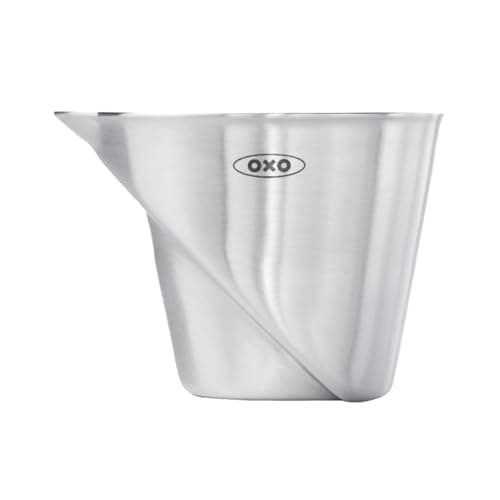 OXO Steel Angled Measuring Jigger Angled interior: you read the line looking straight down. | Easiest to read | $11.95 · View on Amazon #ad Checked October 17, 2026 |
| Japanese style | American style | Angled | |
|---|---|---|---|
| Shape | Tall, narrow, long taper | Short, wide, sharp step | Wide bowl, sloped interior |
| Interior markings | Usually yes — often four lines | Usually none | Yes, and readable from above |
| Measurements available | Up to six from one tool | Two — the rims only | Several, plus tablespoons |
| How you read it | At eye level, against a line | You do not — you fill to a rim | Looking straight down |
| Pouring accuracy | Very good — narrow neck | Good | Fair — wide mouth spills more |
| Best for | Anyone following recipes | Someone free-pouring fast | Anyone who finds small lines hard to read |
A jigger — the little hourglass measure, two cups joined at the waist — is the cheapest object in this entire category and the one that most reliably improves a drink. Cocktails are ratios. Eyeballing an ounce is consistently wrong by a quarter of one, and a quarter ounce of gin in a three-ounce drink is nearly ten percent of the recipe.
The specification almost nobody mentions
Every jigger measures at its two rims. That is a given, and it is where the comparison usually stops.
The variable is interior lines — markings stamped inside the cups at intermediate levels. A jigger nominally sold as “1 oz / 2 oz” that also carries lines at 1/4, 1/2, 3/4 and 1 1/2 oz measures six different quantities. The identical-looking jigger without them measures two.
That matters because of what recipes actually ask for. Three quarters of an ounce of lemon juice, half an ounce of syrup, a quarter ounce of maraschino — these are not exotic amounts, they are most of the classic canon. With an unmarked jigger, every one of them is estimated. The measurements themselves are worth learning if you are buying for someone starting out.
Why the shape changes the reading, not just the look
A Japanese-style jigger is tall and narrow. The same volume of liquid therefore sits higher up a smaller cross-section, so the distance between the 3/4 line and the 1 oz line is large enough to hit reliably. The long taper also pours in a controlled stream rather than a splash.
An American jigger is squat and wide, with a sharp step where the two cups meet. Volume for volume, the liquid level barely moves, which is precisely why these are usually sold without interior markings — there is not enough vertical distance for them to be useful. They are quick and robust and they are a rim-only tool.
The angled design solves a different problem entirely: reading. The interior is sloped so the markings face upward, which means you read the measurement standing over the counter rather than lifting the jigger to eye level or crouching to it. In a dim kitchen, or for anyone whose close vision is not what it was, that is a bigger practical improvement than an extra line.
Which one to buy
Buy a Japanese-style jigger with interior markings for anyone who follows recipes. It is the most measurement per object, it pours cleanly, and it is inexpensive enough to be a stocking gift while being genuinely useful — which is a rare pairing and the reason it appears on the stocking stuffers page as well as here.
Buy an angled jigger if the recipient has said anything about struggling to read small markings, or if their kitchen is dark. Readability beats an extra gradation nobody can see.
Buy neither if their shaker already has a wide-range measuring lid. A shaker measuring from a quarter ounce to six ounces has already solved this, and a second answer to a solved question is the definition of a duplicate gift. Which shakers those are is on the shaker page.
The picks, in full
1. Best overall
Cocktail Kingdom Leopold Jigger, 1 oz / 2 oz
Cocktail Kingdom · best for the small gift that measurably improves every drink the recipient already makes
A jigger — the little hourglass measure — with four interior lines, so one object covers 1/4, 1/2, 3/4, 1, 1 1/2 and 2 oz. It is the cheapest thing on this site that reliably makes someone's drinks better.
Published specs
- Nominal sizes
- 1 oz (30 ml) over 2 oz (60 ml)
- Interior markings
- 1/4 oz (7.5 ml), 1/2 oz (15 ml), 3/4 oz (22 ml), 1 1/2 oz (45 ml)
- Height
- 3.3"
- Material
- 18/8 stainless steel
- Care
- Hand wash only
The math
- Measurements covered by one object: 6
- Two rim capacities (1 oz, 2 oz) plus four interior lines (1/4, 1/2, 3/4, 1 1/2 oz) = 6 distinct measures from a single tool. A plain unmarked 1 oz / 2 oz jigger covers 2.
What’s good
- Six measures in one tool means almost no recipe needs a second fill or mental arithmetic
- Tall and narrow, so the liquid level is easy to read against the line
- Small enough to be a stocking gift and useful enough not to feel like one
What’s not
- Hand wash only
- The interior lines are stamped rather than painted, so they take a moment to find in low light
- It is a small metal cup — as a standalone gift the wrapping has to do some work
Skip this if
Someone whose shaker already has a marked jigger lid, like the OXO or the Elevated Craft. It is a second answer to a question already answered.
#ad We don’t print a price we can’t verify today. We may earn a commission at no cost to you. Disclosure.
2. Easiest to read
OXO Steel Angled Measuring Jigger
OXO · best for someone who will actually read the measurement instead of guessing
The angled interior surface lets you read the line looking straight down into the cup. It sounds like a gimmick until you have tried to measure 3/4 oz at eye level in a dark kitchen.
Published specs
- Sides
- Double sided — 1 oz and 1.5 oz
- Capacity
- 2 oz
- Dimensions
- 2.6" x 3.25" x 2.25"
- Markings
- Ounces and tablespoons
- Material
- Stainless steel
- Care
- Dishwasher safe
The math
- Reading angle required: Straight down
- The patented angled surface puts the markings in the line of sight of someone standing over a counter. A conventional jigger has to be lifted to eye level or read at a crouch.
What’s good
- You read it from directly above, which is where your eyes already are
- Dishwasher safe, unlike most bar-supply jiggers
- Marked in tablespoons as well as ounces, which helps anyone who cooks and does not think in oz
What’s not
- The wide bowl is harder to pour from cleanly than a narrow jigger
- Fewer interior gradations than the Leopold
- The squat shape reads as a kitchen tool rather than a bar one
Skip this if
Anyone buying for a person with an established setup and a jigger they like. This is a replacement, not an addition.
#ad Price checked October 17, 2026. We may earn a commission at no cost to you. Disclosure.
Where these numbers come from
Questions people ask
What is a standard jigger size?
What is the difference between a Japanese and an American jigger?
Do I need a jigger if my shaker has a measuring cap?
Why do interior markings matter so much?
How many ounces is a bar spoon?
Where these numbers come from
Every specification on this page is a figure the manufacturer or retailer publishes. We have not measured any of it ourselves, and every calculation shows its working so you can redo it.