Jigger and bar spoon measurements
The conversion table, plus the reason an inherited jigger makes every drink taste thin.
By Scooter M. · · How we pick
How this page is paid for: the buy buttons below are Amazon affiliate links. If you buy through one we earn a small commission, and you pay exactly the same price. Prices shown were last checked October 17, 2026. Nobody pays to appear here. Full disclosure.
Quick picks
The short answer, ranked. Tap any row to jump to the full write-up further down this page, or go straight to Amazon for the live price.
| # | Product | Best for | Price |
|---|---|---|---|
| 1 | Cocktail Kingdom Leopold Jigger, 1 oz / 2 oz 1 oz and 2 oz rims plus interior lines at 1/4, 1/2, 3/4 and 1 1/2 oz. | Covers six of these measures | Check price on Amazon #ad Live price at Amazon |
| 2 | 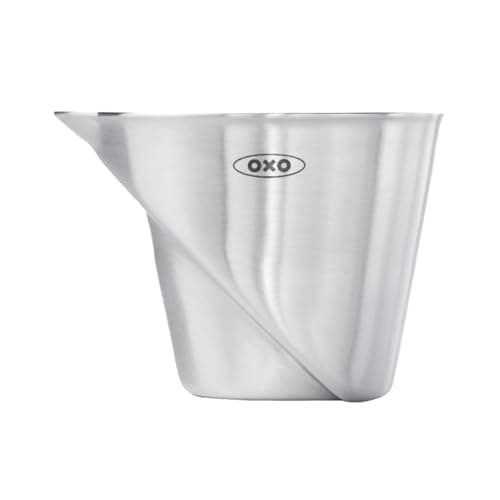 OXO Steel Angled Measuring Jigger Useful for anyone who cooks and does not think in fluid ounces. | Marked in tablespoons too | $11.95 · View on Amazon #ad Checked October 17, 2026 |
| Fluid ounces | Milliliters | Where it appears | |
|---|---|---|---|
| Dash | About 1/32 oz | About 1 ml | Bitters, absinthe rinses |
| Bar spoon | About 1/6 oz | About 5 ml | Rich syrups, maraschino, absinthe |
| Quarter | 1/4 oz | 7.5 ml | Strong modifiers, adjustments |
| Half | 1/2 oz | 15 ml | Syrups, liqueurs |
| Three quarters | 3/4 oz | 22 ml | Citrus juice, syrups — extremely common |
| Pony | 1 oz | 30 ml | Small jigger end; secondary spirits |
| Jigger (traditional) | 1 1/2 oz | 45 ml | Older American recipes |
| Standard pour | 2 oz | 60 ml | Base spirit in most modern recipes |
A standard modern jigger is 1 oz on one end and 2 oz on the other — 30 ml and 60 ml. A bar spoon holds about 1/6 oz (5 ml) and a dash is about 1/32 oz (1 ml). The catch is that many older American jiggers are 3/4 oz and 1 1/2 oz instead, so an inherited jigger under-pours a modern recipe by a quarter on every drink.
The inherited-jigger problem
This is the single most common reason a careful home drink-maker cannot work out why their cocktails taste thin, and it has nothing to do with technique.
The word “jigger” originally meant a specific volume: one and a half fluid ounces. Over time it came to mean the two-cup measuring tool itself, and the tool’s sizes drifted. A great many jiggers sold in the United States over the last several decades are 3/4 oz and 1 1/2 oz, while nearly every recipe published in the last twenty years assumes 1 oz and 2 oz.
Fill the large end of a 1 1/2 oz jigger where a recipe wanted 2 oz and you are 25% short on the base spirit — every time, in every drink. The result tastes watery and unbalanced, and no amount of shaking technique fixes it. Turn the jigger over and read both ends before assuming anything.
Why 3/4 oz is the measurement that matters
Look down the “where it appears” column above and one row does far more work than the others. Three quarters of an ounce is the standard call for citrus juice in a sour, for syrup in a daiquiri, for the modifier in dozens of classics. It is arguably the most-used measurement in cocktail making after the 2 oz base pour.
And it is exactly the measurement a plain jigger cannot make. A rim-only 1 oz / 2 oz cup gives you two volumes; everything between them is estimated by eye down the side of a metal cone. This is the entire practical argument for a jigger with interior markings, and it is why we put one on this page.
A word on dashes
A dash is not really a volume. It is “one downward flick of a bottle with a dasher top,” and the actual amount varies with the bottle, the temperature and how hard you flick. Roughly 1 ml is the working figure.
That imprecision is fine, because consistency within one bottle is what matters. Two dashes from your bottle will always be two dashes from your bottle. Where it goes wrong is transferring bitters into a container without a dasher top — then a “dash” becomes a glug, and three dashes of aromatic bitters becomes a drink you cannot rescue. Any bitters set worth buying ships with dasher tops for exactly this reason.
Metric, briefly
Recipes from outside the United States are written in milliliters, and the conversions are not clean: 1 oz is 29.57 ml, universally rounded to 30. That rounding is harmless. What is not harmless is treating 50 ml as “about 1.5 oz” — it is 1.69 oz, and in a three-ounce drink that error is large enough to taste.
A jigger marked in both units, like the ones on this page, removes the problem entirely. If you are buying for someone who reads recipes from anywhere, that dual marking is worth more than the finish.
The picks, in full
1. Covers six of these measures
Cocktail Kingdom Leopold Jigger, 1 oz / 2 oz
Cocktail Kingdom · best for the small gift that measurably improves every drink the recipient already makes
A jigger — the little hourglass measure — with four interior lines, so one object covers 1/4, 1/2, 3/4, 1, 1 1/2 and 2 oz. It is the cheapest thing on this site that reliably makes someone's drinks better.
Published specs
- Nominal sizes
- 1 oz (30 ml) over 2 oz (60 ml)
- Interior markings
- 1/4 oz (7.5 ml), 1/2 oz (15 ml), 3/4 oz (22 ml), 1 1/2 oz (45 ml)
- Height
- 3.3"
- Material
- 18/8 stainless steel
- Care
- Hand wash only
The math
- Measurements covered by one object: 6
- Two rim capacities (1 oz, 2 oz) plus four interior lines (1/4, 1/2, 3/4, 1 1/2 oz) = 6 distinct measures from a single tool. A plain unmarked 1 oz / 2 oz jigger covers 2.
What’s good
- Six measures in one tool means almost no recipe needs a second fill or mental arithmetic
- Tall and narrow, so the liquid level is easy to read against the line
- Small enough to be a stocking gift and useful enough not to feel like one
What’s not
- Hand wash only
- The interior lines are stamped rather than painted, so they take a moment to find in low light
- It is a small metal cup — as a standalone gift the wrapping has to do some work
Skip this if
Someone whose shaker already has a marked jigger lid, like the OXO or the Elevated Craft. It is a second answer to a question already answered.
#ad We don’t print a price we can’t verify today. We may earn a commission at no cost to you. Disclosure.
2. Marked in tablespoons too
OXO Steel Angled Measuring Jigger
OXO · best for someone who will actually read the measurement instead of guessing
The angled interior surface lets you read the line looking straight down into the cup. It sounds like a gimmick until you have tried to measure 3/4 oz at eye level in a dark kitchen.
Published specs
- Sides
- Double sided — 1 oz and 1.5 oz
- Capacity
- 2 oz
- Dimensions
- 2.6" x 3.25" x 2.25"
- Markings
- Ounces and tablespoons
- Material
- Stainless steel
- Care
- Dishwasher safe
The math
- Reading angle required: Straight down
- The patented angled surface puts the markings in the line of sight of someone standing over a counter. A conventional jigger has to be lifted to eye level or read at a crouch.
What’s good
- You read it from directly above, which is where your eyes already are
- Dishwasher safe, unlike most bar-supply jiggers
- Marked in tablespoons as well as ounces, which helps anyone who cooks and does not think in oz
What’s not
- The wide bowl is harder to pour from cleanly than a narrow jigger
- Fewer interior gradations than the Leopold
- The squat shape reads as a kitchen tool rather than a bar one
Skip this if
Anyone buying for a person with an established setup and a jigger they like. This is a replacement, not an addition.
#ad Price checked October 17, 2026. We may earn a commission at no cost to you. Disclosure.
Where these numbers come from
Questions people ask
What is a standard jigger in ounces?
How many ounces is a bar spoon?
How much is a dash of bitters?
What is a pony shot?
Why do my cocktails taste too strong or too weak?
Where these numbers come from
Every specification on this page is a figure the manufacturer or retailer publishes. We have not measured any of it ourselves, and every calculation shows its working so you can redo it.