Coupe or martini glass?
They hold the same drink. Only one of them reliably gets it to the table.
By Scooter M. · · How we pick
How this page is paid for: the buy buttons below are Amazon affiliate links. If you buy through one we earn a small commission, and you pay exactly the same price. Prices shown were last checked September 14, 2026. Nobody pays to appear here. Full disclosure.
Quick picks
The short answer, ranked. Tap any row to jump to the full write-up further down this page, or go straight to Amazon for the live price.
| # | Product | Best for | Price |
|---|---|---|---|
| 1 | 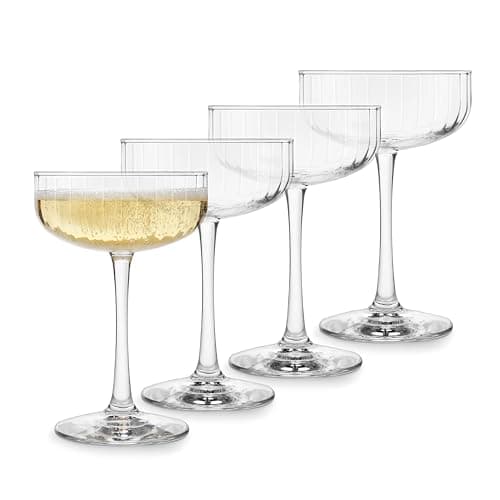 Libbey Paneled Cocktail Coupe Glasses, 8 oz, Set of 4 8 oz coupe, dishwasher safe. Covers the whole up-served canon, including the martini. | If you buy one | $24.99 · View on Amazon #ad Checked September 14, 2026 |
| 2 | 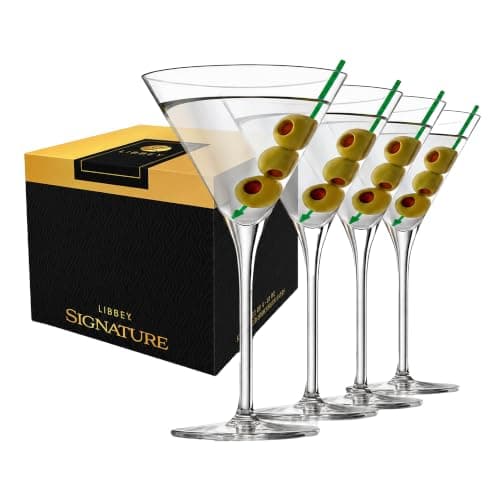 Libbey Signature Kentfield Martini Glasses, 10 oz, Set of 4 The classic V-bowl, with the reinforced foot cheap versions skip. | If you want the silhouette | $44.99 · View on Amazon #ad Checked September 14, 2026 |
| 3 | 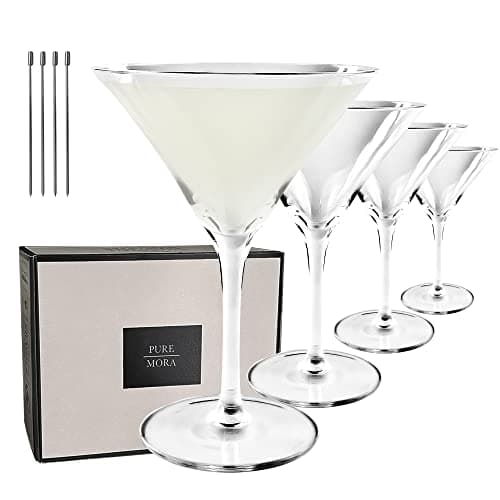 MORA Pure Martini Glasses, 7 oz, Set of 4 A 7 oz V-bowl. Half full instead of a third, so it behaves more like a coupe. | The compromise | $35.99 · View on Amazon #ad Checked September 14, 2026 |
These two glasses hold the same drink at roughly the same volume, and they are not interchangeable in the one way that matters.
A martini glass is widest at the rim. A coupe is widest below it. That single difference decides everything else. On a V-bowl the liquid surface reaches the edge of the glass, so any tilt sends it over. On a coupe the bowl curves inward above the waterline, so a tilt pushes the drink up the inside instead of out. Buy the coupe first.
The geometry, once, because it explains the rest
A martini glass is a cone on a stem. Follow the wall upward and it keeps getting wider until it stops — the widest point is the opening. There is no material above the liquid to contain it, so the glass has no margin for error at all.
A coupe is a shallow bowl. The wall reaches its maximum diameter somewhere below the rim and then turns very slightly inward. That inward turn is the whole product: it is a lip, and a lip catches things.
Everything people say about these glasses follows from that. The martini glass “shows off” a drink because the surface is maximally exposed. It also warms faster for the same reason, and spills for the same reason again. One property, three consequences.
The two shapes on published numbers
| Shape | Published capacity | Rim diameter | Fill at a 3.5 oz pour | |
|---|---|---|---|---|
| Libbey Paneled coupe | Coupe | 8 oz | 4" | About 44% |
| MORA Pure | V-bowl | 7 oz | 4.61" | About 50% |
| Libbey Kentfield | V-bowl | 10 oz | 4.6" | About 35% |
The interesting row is the middle one. The 7 oz MORA is a V-bowl, so it has the geometry problem — but at 7 oz the drink sits at half depth rather than a third, which puts the surface further below the rim than the 10 oz glass manages. A smaller V-bowl behaves more like a coupe. That is the compromise position, and it is why a small martini glass is worth seeking out.
Note also the rim figures: both V-bowls are wider at the mouth than the coupe despite holding the same or less. Wider mouth, shallower liquid, more exposed surface — the three things you do not want on a drink being carried.
Where the martini glass genuinely wins
This site is not in the business of pretending a popular thing is worthless, and the V-bowl has real advantages worth stating.
- It is instantly readable. No other glass says “cocktail” from across a room. For a dinner party that is not nothing.
- The aroma is fully exposed. All that open surface delivers the gin or the vermouth straight up at you, which is the point of a spirit-forward drink.
- Garnish has somewhere to sit. A twist or a skewer of olives lies across a wide rim in a way it cannot on a narrow one.
If those matter more to you than a dry wrist, buy the martini glass and buy it small — the martini glass page compares the sizes properly.
Which one to buy first
Buy the coupe. It takes the martini, the daiquiri, the sidecar, a Manhattan served up, champagne and an espresso martini, and it gets all of them to the table. If you own one stemmed shape, this is the one that earns the cupboard space.
Buy the martini glass second, and buy it for what it looks like, because that is what it is for. If you do, the 7 oz MORA is the version that behaves — a smaller V-bowl keeps the liquid further from the rim and takes most of the drama out of the shape.
And if you want the shape that spills least of all, a Nick and Nora is a coupe that has committed harder. It holds less, which is either the point or the problem. The full shape guide puts all of them in order.
The picks, in full
1. If you buy one
Libbey Paneled Cocktail Coupe Glasses, 8 oz, Set of 4
Libbey · best for an espresso martini, a daiquiri, and anything else served up without ice
Eight ounces of lead-free glass made in the USA and rated for the dishwasher, with a paneled bowl that hides the fingerprints a plain coupe shows. It is the least expensive honest answer to the espresso martini question.
Published specs
- Capacity
- 8 oz
- Set size
- 4
- Dimensions
- 5.97" tall x 4" diameter
- Set weight
- 1.64 lb
- Material
- Lead-free glass
- Origin
- Made in the USA
- Care
- Dishwasher safe
The math
- Room left for foam on an espresso martini: About 3 oz
- An espresso martini is roughly 4.5 to 5 oz once shaken. In an 8 oz coupe that leaves around 3 oz of clear glass — which is where the crema sits. Pour the same drink into a 5 oz glass and the foam goes over the side.
What’s good
- 8 oz is the size that holds the drink and the foam without either crowding the other
- Dishwasher safe and made in the USA, both published, which is rare at this price
- The paneled bowl disguises marks that a plain coupe puts on display
What’s not
- At 4" across the rim it is a wide coupe — it spills more readily than a Nick and Nora
- Pressed glass has a thicker rim than crystal, and you can feel it
- The panels are a look; if you want plain, this is the wrong set
Skip this if
Anyone who wants the drink to sit in something delicate. This is a working coupe, and it looks and feels like one.
$34.99 — 29% off
#ad Price checked September 14, 2026. We may earn a commission at no cost to you. Disclosure.
Where these numbers come from
2. If you want the silhouette
Libbey Signature Kentfield Martini Glasses, 10 oz, Set of 4
Libbey · best for the classic v-shaped martini glass, in the size most recipes are written for
The shape everyone pictures when they hear the word martini, made by the company that supplies most American bars. Ten ounces is generous for a three-ounce drink, which is exactly the trade-off a V-bowl asks you to accept.
Published specs
- Capacity
- 10 oz
- Set size
- 4
- Dimensions
- 7.68" tall x 4.6" diameter
- Set weight
- 2.4 lb
- Material
- Lead-free glass
- Bowl
- V-shaped, with a reinforced flat foot
- Care
- Dishwasher safe
- Model
- 9136/L005A
The math
- How full a standard martini fills it: About a third
- A classic martini is roughly 3 to 3.5 oz once stirred and strained. In a 10 oz bowl that is about 35% full — and because a V-bowl is widest at the rim, the liquid sits shallow and close to the edge. That geometry is the whole reason a martini glass spills.
What’s good
- The reinforced flat foot is the part cheap martini glasses skip, and it is what stops the stem snapping in a dishwasher rack
- Dishwasher safe, which for a stemmed glass is not a given
- Arrives in a gift box, so it works as a present without further wrapping
What’s not
- A 10 oz V-bowl is a lot of open surface for a 3 oz drink — this is the shape that spills
- The wide rim warms the drink faster than a coupe of the same volume
- Four glasses is the right number for a couple and short for a party
Skip this if
Anyone who has ever carried a full martini across a room and regretted it. A coupe holds the same drink with a narrower rim, and it is the better glass for most households.
#ad Price checked September 14, 2026. We may earn a commission at no cost to you. Disclosure.
Where these numbers come from
3. The compromise
MORA Pure Martini Glasses, 7 oz, Set of 4
MORA · best for someone who wants the martini shape without the puddle it usually creates
Seven ounces instead of ten, which sounds like less glass and is actually the more sensible one. A 3 oz drink fills half of it rather than a third, so the liquid sits lower, further from the rim, and moves less.
Published specs
- Capacity
- 7 oz
- Set size
- 4
- Dimensions
- 6.3" tall x 4.61" diameter
- Set weight
- 1.61 lb
- Material
- Handblown lead-free crystal glass
The math
- How full a standard martini fills it: About half
- 3 to 3.5 oz of drink in a 7 oz bowl is roughly 50% full, against about 35% in a 10 oz glass. The liquid sits deeper and further below the rim, which is the single thing that decides whether a martini survives the walk from the counter.
- Weight per glass: About 6.4 oz
- 1.61 lb across four glasses is 0.4 lb each, or about 6.4 oz. That is light for handblown glass, which is a fair warning as much as a selling point.
What’s good
- 7 oz is the more usable martini size, and almost nobody sells it
- Handblown rather than pressed, so the stem and bowl meet without a molded seam
- Lead-free, which matters for a glass a drink sits in while you talk
What’s not
- Handblown glass is thinner and more fragile than Libbey's pressed stemware
- No dishwasher-safe claim is published, so treat it as hand wash
- 7 oz is too small for anyone who pours a generous martini, which is most people
Skip this if
A household that puts everything in the dishwasher. Nothing in the published specification says these survive it, and thin handblown stems are the first casualty.
#ad Price checked September 14, 2026. We may earn a commission at no cost to you. Disclosure.
Where these numbers come from
Questions people ask
Is a coupe better than a martini glass?
Can you serve a martini in a coupe?
Why does a coupe spill less than a martini glass?
Which glass is better for an espresso martini?
What about a Nick and Nora?
Where these numbers come from
Every specification on this page is a figure the manufacturer or retailer publishes. We have not measured any of it ourselves, and every calculation shows its working so you can redo it.